

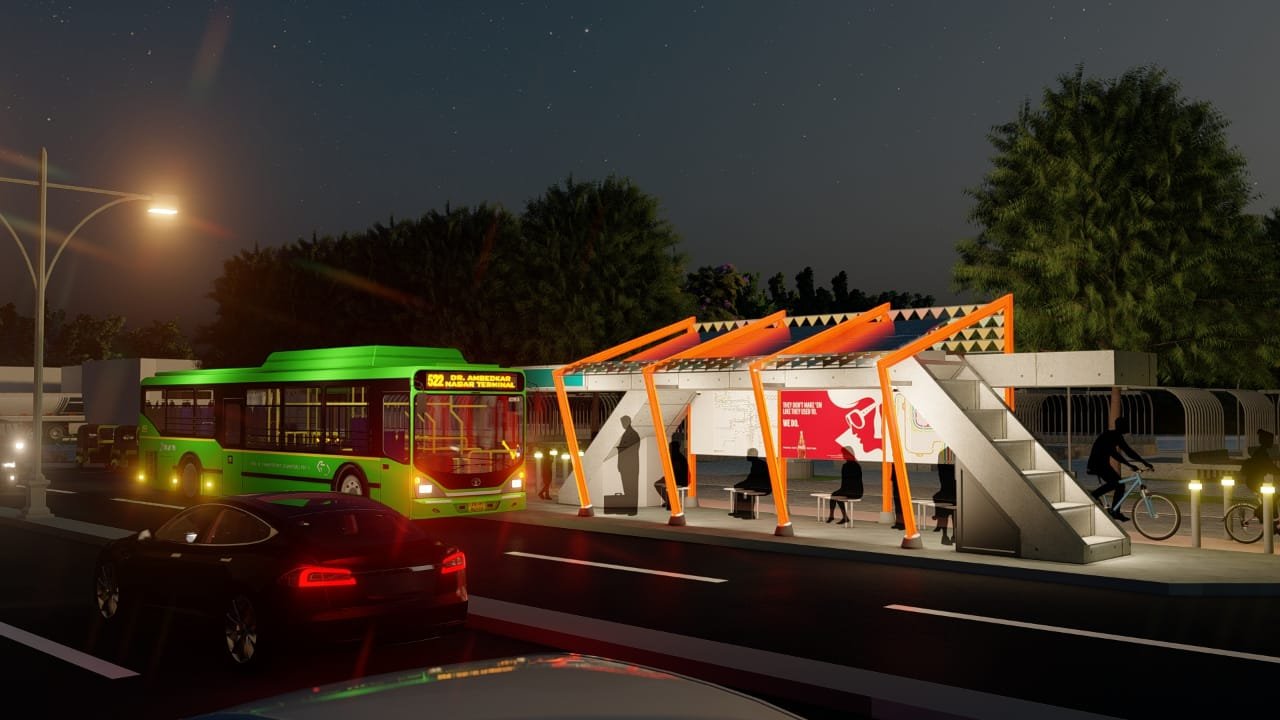
The team of Professor and Students of SMEF’s Brick School of Architecture from Pune reimagined the future of bus stops in an international competition ‘Better Bus Stop’ organized by BOUN and UNI.
Their entry was shortlisted in the Top 27 from all the entries worldwide, out of which 3 entries were from India. Their proposal, ’Aashray’ was immensely appreciated with the highest count of votes and was rewarded with the People’s choice award.
The Principal of the college, Dr. Poorva Keskar said, “Majority of the Bus stops in India follow standardized design solutions which are the same in different cities. Pune is one of the leading Smart Cities of the first 100 chosen Smart cities of India. We were happy to see the ability of our students to grasp the scale and needs of the localities, and their ability to propose inclusive solutions for the same. We are proud of the entire team and we congratulate them on their achievement”
Ar. Ninad Rewatkar shares his idea on how the design focuses on keeping Bus stop a net-zero energy system. “The solar panels above will operate the submersible pumps to give a 24/7 Public drinking water facility, making it a self-sufficient module. It will also charge batteries for all the sensor-based ceiling-facing diffused lighting systems that operate as per occupancy. It will operate the running and storing of surveillance footage stored by two CCTV cameras. Both of these features will ensure the safety of citizens as this will make all bus stops as Safe houses at night.”
“Keeping in mind, how the bus stops can be installed in very less time on the site, as well as providing a solution which will work on narrow roads of dense core areas, we proposed to build this with 4 X 4 feet hollow precast panels which are of light in weight, which can be assembled by post tensioned cables on site,” said Aditya Sawalkar addressing the Modularity and Structural technology of the bus stop.
“The precast panel will be supported by the I-section frame work which will have Lighting and electrical systems incorporated to alert our passengers 2 mins before the arrival of their respective bus. The number of I-sections can be reduced or increased depending upon the local footfall, thus modulating the overall length of the bus stop depending upon various sites in the city”, explains Rushali Rokade.
“Through the course of the competition, we were guided by our professors Ar. Abhang Kamble and Ar. Bhagyashree Bandekar and we are grateful to them. Abhang sir being the local resident helped us a lot in understanding the context of the site. Their valuable guidance helped us a lot in our proposal.” said Siddharth Kadam.
The approach to developing the bus stops is mostly top-down, because of many reasons – attributed to speed scaling and easier deployment. And it is true; every bus stop looks the same from a development plan perspective – a dot on a huge urban map. But conversely, every bus stand installed is an opportunity to solve a need of a locality if we see it bottom-up.